Pamela Wheeler·Fellows and Bonzo's companionship
Pamela's WarPamela Wheeler/Fellows and Bonzo's companionship begins as a response to upheaval and grows into the most intimate attachment of her childhood. Promised and then presented with a little brown terrier puppy when the family is preparing to move, Pamela names him Bonzo; he sleeps on her bed, waits for her return from school, and becomes the companion she cannot imagine losing. His death in wartime darkness turns an exuberant, mischievous relationship into a first encounter with irreversible grief.
A Friendship Born from Displacement
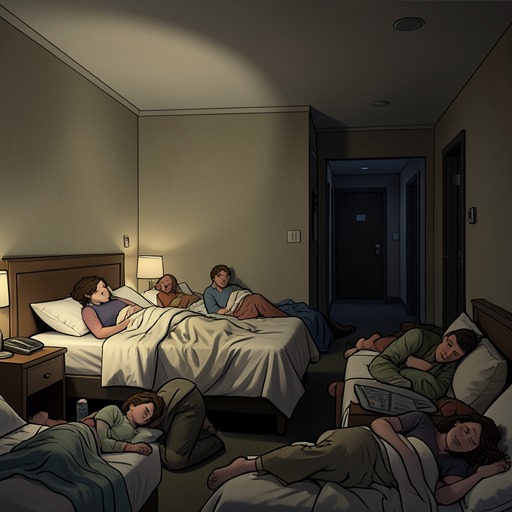
Bonzo enters Pamela’s life at a moment when change threatens the security of the familiar. Children are described as resistant to being moved, and the promise of a dog appears to soften the news that the family will relocate. The gift does more than distract her. Bonzo provides continuity while the family’s surroundings are about to change, and his arrival establishes a private world shared by child and animal rather than controlled by the practical demands of the household or hotel.
He is small, brown, and a terrier, but the narrative quickly gives him a significance far larger than his size. He sleeps on Pamela’s bed, and the two become inseparable. The physical arrangement matters: Bonzo is not merely a household pet kept at a distance, but a bedfellow and constant presence. Their companionship is enacted through proximity, routine, and waiting. When Pamela leaves for the morning bus, Bonzo reluctantly allows her to pass out of his sight; when she returns, he is always there to receive her. The daily repetition makes the attachment dependable. School divides their hours, but it does not weaken the bond.
Bonzo’s Independent World
Bonzo’s life away from Pamela is not empty or passive. While she is at school, he ranges beyond the hotel, forms friendships with the local canine population, and acquires several canine lady friends. The story even reports a neighborhood rumor that, in time, many puppies appear with Bonzo’s colouring and features. Whether treated as fact or affectionate local legend, the rumor enlarges his character: Bonzo has an active social and sexual life beyond the family, while still returning to Pamela as the centre of his domestic attachment.
His freedom also produces consequences for other people. He regularly steals walnuts from the small shop next to the hotel, carrying each prize away to eat in peace before returning for more. The grocer points out that the dog is consuming what little profit sustains him, so the walnuts are moved beyond Bonzo’s reach. The episode places the dog within the material pressures of wartime scarcity: his appetite is comic from the family’s perspective, but it collides with a struggling neighbour’s livelihood.
Bonzo’s intelligence gives the relationship another dimension. He understands spoken instructions with striking precision, though not necessarily the human intention behind them. When Pamela’s Mother tells him to get her a chookie so that she can take an afternoon nap, Bonzo obeys literally. A large white chicken is ceremoniously deposited on the lawn outside her bedroom window, dead; before anyone can stop him, Bonzo adds three more chickens to the cache. The fourfold delivery is both an act of obedience and an act of predation. The family pays the chicken owner, Mr Coles, offers apologies, and promises that it will not happen again, while concealing the awkward truth that Bonzo was following instructions exactly.
His appetite repeatedly tests the boundary between affection and responsibility. Although the hotel kitchens provide enough food, Bonzo enjoys separating people from whatever they are eating, even when their provisions are meagre. He targets an old man in the front bar whose lunch consists of limited bread and a small amount of cheese tied in a cloth, with a rusty knife for cutting it. Sitting on his hind legs, whining and begging with an appealing expression, Bonzo wins the larger share of the man’s lunch. The performance is nearly theft, though the dog has at least earned it through his talent for persuasion. His charm does not erase the selfishness of the act; it makes that selfishness lovable, embarrassing, and difficult to resist.
Shared Pleasure and Everyday Attachment
The clearest sign of Bonzo’s special place in Pamela’s life is the shared excitement of going out in the car. One or two blasts of the horn are enough to bring him running, however far he has wandered. He appears with his tail wagging, ready for a trip, and shopping becomes one of his favourite activities. The car therefore serves as a recurring bridge between his independent roaming and his companionship with Pamela: it gathers him back into the family’s movements and turns an ordinary errand into a shared pleasure.
This enthusiasm later acquires an unintended tragic force. The motorcar is one of the things Bonzo loves most, but the vehicle also becomes the instrument of his death. The earlier image of the dog racing happily toward the horn remains inseparable from the later image of a car moving through darkness. The relationship’s memories are consequently not only tender or comic; they are retrospectively shadowed by the very object associated with Bonzo’s greatest delight.
Bonzo’s place in the household also contrasts with the wartime status of animals elsewhere in Pamela’s world. Food scraps are collected to fatten England’s pigs, a pony and trap replaces petrol-dependent transport for Jim and Renee Parkes, and Pamela’s Grandmother eventually commandeers a baby’s new pram to carry food during rationing. These animals and animal-related objects are drawn into systems of survival, transport, and national need. Bonzo remains entangled in that same material world—he steals scarce food and depends on vehicles—yet his meaning to Pamela is irreducibly personal. He is not merely useful, consumptive, or replaceable. He is the beloved individual whose presence makes home feel inhabited.
War, Darkness, and Loss
The war eventually takes Bonzo from Pamela, as it takes many people and attachments from her life. The immediate setting is the blackout, when curtains and blinds must prevent even a chink of light from guiding foreign aircraft. At the hotel, the car-park lights are extinguished, and in the countryside the darkness becomes complete when there is no moonlight. The blackout is designed as collective protection, but it also makes ordinary movement hazardous. War reaches into the smallest domestic space not only through bombing and shortages, but through the altered conditions under which a familiar animal moves.
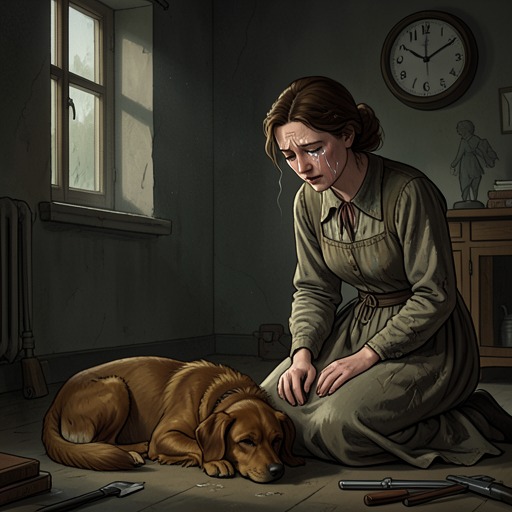
Bonzo is run over in the hotel car park and killed. The irony is exact: the motorcar that once summoned him joyfully to shopping trips now ends his life. Pamela does not blame the driver. The permitted headlights produce only a useless two-inch diameter of light, leaving the driver unable to see properly. Bonzo’s death is therefore an accident of war rather than a simple instance of individual carelessness. The blackout converts a familiar place into a lethal one and makes the tragedy a consequence of regulations imposed for national survival.
The family attempts to protect Pamela from the truth. Bonzo is buried in the garden, but no one tells her where. For several days, people say that he has run away. Pamela knows that he has not. Her certainty is important because it marks a limit to the comforting stories adults offer during crisis: she understands the disappearance through the bond itself, through knowledge of Bonzo and the impossibility of his simply abandoning her. The concealment delays the admission of death without preventing her from recognizing it.
The loss breaks the value that had governed their relationship. Pamela had adored Bonzo and could not imagine being parted from him; afterward, she describes him as her beloved and faithful friend, says that her heart is broken, and records that she has never felt pain like it before. The grief is not an ornamental conclusion to a pet story. It is the first fully registered bereavement in a narrative repeatedly shaped by wartime separation. Bonzo’s death teaches Pamela that the war can destroy the private attachments that make childhood secure, even when the immediate cause is a badly illuminated car park rather than a battlefield.
Narrative Significance
Bonzo embodies companionship as a form of shelter. He arrives to ease a move, shares Pamela’s bed, waits at the bus route, returns at the sound of the car horn, and fills the family’s life with thefts, mistakes, appetites, and comic intelligence. His presence gives childhood a stable emotional rhythm while the wider world becomes less stable. The dog’s agency is essential to that meaning: he is mischievous, socially active, clever, hungry, and capable of causing real inconvenience. Pamela’s love is not directed toward an idealized animal without faults, but toward a vivid creature whose faults are part of his individuality.
The ending refuses to separate private feeling from historical circumstance. Bonzo’s death occurs under blackout conditions, amid the practical restrictions and dangers imposed by the Second World War. The same war that organizes food collection, transport substitutions, military preparation, and the family’s eventual movement toward Birmingham also transforms darkness into a threat and makes the car into a fatal object. Through Bonzo, the large history of wartime Britain becomes intimate: national precautions enter the hotel garden, alter the visibility of a driver, and leave Pamela with a grave whose location she is not even told. His companionship is therefore both a cherished childhood relationship and a measure of what war removes from ordinary life.